Research and Monitoring
Gluepot is being developed as a Quality Centre for Scientific Research, and is ideally suited to a diverse range of biological research projects. All areas of the Reserve are open to use by researchers, and the Birdseye Block, an area of 17 000ha of old growth mallee, has been specifically designated as a core reference area (research and conservation access only) - public access to the block is restricted.

Current Monitoring & Research
Banding
Research Policy and Services
Contacts


Current Monitoring and Research

The National Black-eared Miner Recovery team is conducting intensive ecological and behavioural research at Gluepot. Over 50 colonies have been mapped and studied (with an average of 18 birds per colony) and 200+ birds colour banded. There are 8 sites where colonies are monitored using taped calls. Biological samples for DNA analysis have been collected from all banded birds.

A PhD study is underway studying the influence of artificial watering points on grazing herbivores and their impact on bird habitat (Melbourne University).

A PhD project on the ecology and breeding habits of the Black-eared Miner is nearing completion (La Trobe University) and a second PhD (La Trobe University) on a Black-eared Miner morphology monitoring genetic introgression is underway.

An honours project is about to commence using remote sensing to grade ecologically sensitive areas on Gluepot (Adelaide University).

The Geography Department of the University of Adelaide has 36 permanent photopoint sites, at each of which a 30 x 30 m quadrat and a 4 x 100 m transect has been established. These quadrats are monitored annually and cover all plant communities present. Quadrats and transects co-occur with sites used for monitoring bird and reptile communities.

The South Australian Pastoral Board has established twelve 4 x 100 transects within which 1 m2 nested quadrats are placed for collection of more detailed data. Together, transects and quadrats provide observational and quantitative vegetation data. These sites are monitored annually.

As part of a long-term biological monitoring strategy for Gluepot, six 2km x 1km Malleefowl grids are being established, to study the movements, abundance, breeding habits and recovery process of this species. Annual data from grids will also assist in assessing the potential impacts of management strategies.

In 1998, as part of the water points study, 75 bird Atlas sites were established in representative samples of all vegetation communities and in varying distances from water points. Each site has been accurately mapped and surveyed for vegetation. In 1998-99 Gluepot Reserve was the leading data contributor to the bird Atlas scheme. As well as the data collected by research personnel, many visitors to the Reserve also Atlas at these sites.

Permanent pitfall lines have been established at 52 of the Atlas sites, and these are monitored for reptiles, mammals and invertebrates. As part of the National Weather Grid, the South Australian Bureau of Meteorology has established a climatological station at the Homestead. Data is collected twice daily and transmitted to the Bureau in real-time. Additionally, the Reserve maintains its own automatic weather station sited in another part of the Reserve, with data downloaded to the Reserve computer.

An active Grazing and Feral Animal Management Program controls goat, fox, cat and kangaroo numbers and independent techniques are being developed for monitoring the efficiency of these control programs.

A weed management program is being designed.

Gluepot has been floristically mapped (both in published and electronic formats) and a handbook of the vegetation of the Reserve published. The Reserve maintains a herbarium of all species collected.

In late 2000, a two week intensive research expedition will conduct biodiversity studies at the permanent pitfall sites; a study of the gypsum lakes and their associated vegetation; a survey of the bats occurring on the Reserve and colour banding of cryptic bird species at two of the Malleefowl grid sites.

To top of page


Banding

Gluepot Reserve currently has a mallee bird community banding program co-ordinated by A-class bander Wally Klau. Bird banding has also been undertaken on the Reserve by researchers working on the Black-eared Miner recovery program and by Wally Klau when assisting a PhD student studying the impact of artificial water points on mallee bird communities.

Malleefowl grids are widely-spaced through the Reserve, and their vegetation communities are defined on the Reserve's GIS database. They have individually coded reflector discs set every 25 m along grid lines placed 200 m apart making them an ideal research tool. Bird banding activities are concentrated on three grids. All species mist-netted are banded, and selected resident species will be colour-banded to facilitate long-term behavioural and ecological studies.

Species selected for colour-banding include: Striated Grasswrens, the four species of whistler (Red-lored, Gilbert's, Rufous and Golden), four species of ground-dwelling bird (Southern Scrub-robin, Crested Bellbird, Chestnut Quail-thrush, Shy Heathwren) and two species of robin (Hooded and Red-capped). Black-eared Miners captured will be colour- banded using the banding combinations provided by the Black-eared miner Project Officer. Other species will be colour banded in the future if appropriate long-term or intensive research projects on them are proposed and approved.

To top of page


Potential Research Projects

Gluepot Reserve provides outstanding opportunities for research on several threatened or declining species, as well as common mallee birds. Future research projects could target:

  • The mallee bird community at Gluepot and compare it with areas which have different fire and grazing histories, and not many ancient mallees.

  • Striated Grasswrens - threatened, and yet common at Gluepot.

  • Red-lored Whistlers (disappeared from some sites in western Victoria), and the other three species of Whistler.

  • The four species of ground-dwelling bird (Southern Scrub-robin, Crested Bellbird,
  • Chestnut Quail-thrush and Shy Heathwren).

  • White-fronted Honeyeaters - both common and accessible.

  • All of the cryptic species could be colour-banded on one or two of the Malleefowl grids as a precursor to more detailed student projects. Malleefowl grids are an ideal resource for studying other species (eg territories of ground-dwelling birds).

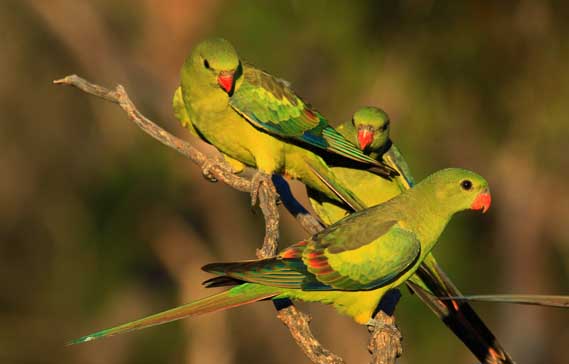
  • Regent Parrot feeding ecology.

  • Other groups of common birds highly suitable for study at Gluepot are:
    nightjars (2 species), parrots (4), treecreepers (2), fairy-wrens (2), honeyeaters (8), robins (2), babblers (2), woodswallows (4) and the Apostlebird.

  • Gluepot's rich reptile population may show a greater and earlier response to management regimes than birds because they are less mobile and are generally more affected by changes to the ground layer.

  • There are opportunities to record some species of small mammals likely to be captured in the pitfall traps set for reptiles. The Bookmark Biosphere Trust has a small mammal survey program which could be extended to Gluepot.

  • Frogs can be surveyed and monitored annually as part of the Environment Protection Authority’s ‘Frogwatch’ program.

  • Among invertebrates, ants are a very diverse and numerous group in the Mallee. They are good indicators of environmental disturbance and recovery, and they will be captured as a by-product of pitfall trapping. CSIRO is undertaking invertebrate surveys in neighbouring areas and it is anticipated that this will be extended into Gluepot.

    Members of the Gluepot Reserve Research and Monitoring Committee can assist students and other researchers in the formulation of project proposals. Present research projects will provide valuable assistance to the rural community in the areas of the influence of artificial watering points on habitat; methodology to identify ecologically sensitive areas; long term feral control and land management practices that are both ecologically and culturally sustainable. Through the research, monitoring, training and educational programs, Gluepot is contributing to the conservation of landscapes, ecosystems, and species and genetic variation which are directly related to regional, national and global conservation and sustainable development issues.
    Gluepot is a community-run reserve and is open to anyone. The Reserve offers an opportunity for the community to value the region’s natural resources and to explore the ways in which they are important to the quality of life far into the future. Additionally, university graduates and under graduates are given the opportunity to undergo reserve management training as Assistant Volunteer Rangers.

    To top of page


    Research Policy and Services

    To download a copy of the Gluepot Research Policy and Summary of Services click here

    To top of page


    Contacts


    REQUESTS TO UNDERTAKE RESEARCH
    To download an application form click here


    Requests to undertake research projects on Gluepot Reserve should be submitted in writing using the Application to Undertake Research and Surveys protocol forms, to Gluepot Research and Monitoring Committee.

    To top of page


  • Scarlet-chested Parrot

    Mallee & Bluebush

    Mallee & understorey